Wednesday, 28 July 2010

WITH SEVEN HEADS BUT ONLY ONE BODY, CO-ORDINATION MUST HAVE BEEN AN ABSOLUTE NIGHTMARE!

I haven't posted a word since 9th July. I'm mortified, ashamed, filled with remorse, shocked and contrite. Sorry. Sorry. And sorry, too, for being so behind with everyone else's post. I see there are Garden Monkey posts. Goody! But no JAS posts - or am I missing them since he went all Wordpressy.

BTW - the title refers to the dragon in the Mediaeval Tapestry of the Apocalypse, at Angers.


The garden at L'Hôpital Saint Jean, Angers - in Anjou - built by Henry the Second as penance for having Thomas Becket bumped off. It now accommodates a museum featuring the work of tapestry artist Jean Lurcat. See about him here.


The garden was dry and dead. Now it's wet and dead. I walk like The Curse of the Mummy and will need surgery on spine and hip. Harrruummmph!!!! My days are made tolerable by iPod, iPhone, iPad and iBuprofen - ha! ha! The latter I take in gargantuan doses, but I'm more seriously addicted to the iPad which I absolutely love apart from one or two MADDENING things . . . but there'll be some serious colborning on that one, soon.

The hyped up ibuprofen pills are a shockingly bright pink, presumably designed as lures for small children and have to be taken with food - pills, that is, not children. I find whisky a good accompaniment, especially if there's also some dark chocolate.

Our most riveting garden event since 9th July was the flowering of my tuberose Polianthes tuberosa. The fragrance is complex and erotic and for some days, Wendy has been smelling like a scene from the Tales of a Thousand and One Arabian Nights. She's also burgeoning with tomatoes and cucumbers, both kinds - 'lunch box' and 'impressively endowed.'

The best tomatoes are 'Sungold.' The new variety 'Cherry Falls' has as much flavour as a tissue moistened with distilled water. It's high-yielding, but what good is that if the flavour is so feeble? I shan't grow it again.

The old variety 'Tigerella' tastes almost as bland as 'Cherry Falls' but it looks prettier when ripening. The big, Marmande tomatoes I bought in Carrefour, in Calais, last week, tasted better than all of mine mine, apart from 'Sungold' which, as I've already said, is the best.


I promised a little more about Angers and Terra Botanica. I think it's best told in pictures so I'll keep the wordage brief.

The interior of the Saint John (Jean) hospital, now serving as a museum whose main treasure is a modern Apocalyptic Tapestry by Jean Lurcat. It was inspired by the Cold War. Lurcat served in trenches, in the First War and was a member of the Resistance during the German Occupation in World War 2.

The city is totally charming, with masses of ancient buildings - cathedral, one of France's largest Mediaeval castles, the Cathedral of Saint Maurice, abbey, churches and much more besides. Narrow cobbled streets in the old part of town are almost traffic-free and the view from the river bank, looking back to the oldest part of the Angers is delightful.

Outside the Musée de Beaux Arts. Sorry, I didn't record the name of the artist - rubbish journalism!

My assignment was to write a travel piece about Angers and particularly to report on Terra Botanica, a new theme park occupying a 17 hectare site on the city's outskirts. What a dream of a job!


Terra Botanica - the restaurant, looking through the animated fountains. The food was designed by local Chef Pascal Favre d'Anne (see him here) and and includes top notch hamburgers - yes, hamburgers BUT eco-friendly and made exclusively from local farms. He calls them 'Hambur 'verts'


The 17 hectares are divided into four big theme gardens covering plant hunters, crops and economic crops, botany and horticultural science and local Maine-et-Loire horticulture crop farming and viticulture. There are lots of gardens, film shows, animated shows and boat rides. You can learn more here.


Stylised washing as an art form in Terra Botanica


A quiet place - unusual in this frenetic theme park.


Grass gardening at Terra Botanica

I'm Listening to, would you believe, the Yin Tong Song from the Goon Show. Ying tong diddle I poh!

This time last year I could walk five miles without aching. Now I do well if I can cover five hundred yards.

The film - well, Telly Programme was Sherlock, the new BBC 1 drama. It was OK, up to a point but irritating at many levels. Great story, intelligent transmogrification from Victorian Baker Street. BUT - the filming drove me nuts and a taxi chase, with the anaemic looking Holmes and Watson on foot was daft. But thank heavens for a Dr Watson who isn't a knucklehead - now that's far closer to the real Conan Doyle. Plus, they're sort of metrosexual, type thingies. Tom Sutcliffe gave it an orgasmic review in The Independent. I wonder if he's a good friend of Mark Gatiss????

Good Byeeeee

Friday, 9 July 2010

BUSTED BANGERS, FRIZZED COURGETTES, BLACK SWEETCORN AND RAW CHICKEN.

NOW THEN, NOW THEN! (Why do people say 'now then?' It's nonsensical - a self contradiction in two words. Barmy. We should think up a new way of ahemming for attention.

But to get to the point:

The image below is included mainly for the delectation of Ms Arabella Sock, in recognition of her illustrious blogging achievements in food, gardens and other mises en bouches of this extraordinary life, and in particular as a mark of congratulation on her NEW FENCE.

The piccy is of a wall made entirely of gabions - those abominations of engineering, crafted to stop cliffs falling onto motorways but snatched up gleefully by assorted garden designers, and those who go through the motions of design (you know who you are.)

Named after 'gabbione' which is, according to Wikipedia, Eyetie for 'cage,' these objects, like vertical gardens, black granite kitchen surfaces, carpetless restaurants and those things that super-chefs use to turn perfectly good food into cuckoo spit, will eventually be recognised for what they are - banes, rather than boons to Mankind, and to Man Unkind as well, for that matter.

Anyway, as a mark of respect, I dedicate this gabionic construction to the Sock who, I suspect, actually has a tiny gabionini somewhere about her garden.


I have to say, that this particular wall of gabions, with its streaks of coloured stones, including limestone, slate from schist and some reddish stuff I wasn't able to identify is rather impressive.

I spotted it in the new Terra Botanica, an 'Edutainment Park' at Angers, in Anjou. More on that later, when I've picked up the rest of the piccies from Boots. (The PG stayed at home, so the pics will probably be substandard.)

Joyful things.
1. The swallows have flown their nest - all five - and now zoom about the garden by day but rush home to Mum and Dad for night roosting in the garage. They've crapped all over the barbecue which will probably improve the flavour of my burnt offerings next time it's wheeled out for use.

2 Last summer was such a pile of pants, weatherwise, that I don't think we barbecued once. This year, each week end, we sacrifice sausages or chicken with veggie kebabs and sweetcorn which is nicer, if almost but not quite burnt to ruination, rather than boiled up in a saucepan in the kitchen.

3. Wendy, the greenhouse, has produced a tuberose flower spike, despite my inept plant management in which I managed to rot off two of the three bulbs.

4. The mock orange in the shelter belt which hides our back garden from the village street is full of blossom. We can't see a single flower - they're all on the street side - but when in bed, with the windows open, the entire room is filled with delicious scent.

5. The iPad is amazing. I'm reading Penelope Lively's Family Portrait on it. The book cost a little less than a paperback but is more convenient. I can alter the font, the type size, can book mark where I got to and so on. What an absolutely brilliant gadget this machine is.

AND
A very, very sad thing.
I looked out of the window this morning and saw that one of the swifts which nest in our roof had fallen. Swifts live almost every moment of their lives on the wing, landing only when they nest. They even sleep on the wing. This one had probably been hit by a raptor - we have a marauding hobby which swoops over frequently, trying to snatch up swallow or house martins and was lying, with a few feathers round it, on our terrace.

I picked it up and tried to launch it - that's what you do with a fallen swift. The tiny legs, almost vestigial, end in long, sharp claws which grip with amazing tightness and pierced my skin. That surprised me because it had seemed very weak. It was a young bird, hatched this year and until now had obviously been healthy and in good order. I tried a launch, but alas, it was too badly hurt and unable to fly. My attempts merely caused it further distress, and there was, very sadly, only one further option.

That put a big black cloud over the morning. Nature is a vicious, nasty, ruthless bitch and there are times when I really hate her. It shouldn't have to be so agonising, but it is. Damn it.


My meadow thrives, despite the drought. Lady's bedstraw and field scabious are flowering for the first time this summer but our star wildling was still the spotted orchid which we spotted - ha ha - earlier. It's the one place where I'm actually allowing lesser bindweed, Convolvulus arvensis. I think it will do no harm and you cannot deny that the flowers are exquisite. Distinctly prettier than C. sabateus, which we pay good money for, and also rather more variable.

I'm listening to Schubert's Der Winterreise, A legendary recording with Benjamin Britten accompanying Peter Pears. Britten's playing is riddled with verve and vim.


This time in 2006 I had gout in my right foot but managed to prune a big Ceanothus dentatus and a small Brachyglottis greyi before watching Federer beat Rafael Nadal. The PG and I watched Ingmar Bergman's The Seventh Seal, that evening.

This week's adventure was to travel by train from Peterborough to Kings Cross, to Saint Pancras, to Lille and thence to Angers. What a thrill to be in Anjou, the epicentre of the Plantagenet Dynasty and to bathe in Angevin culture for three delirious days. And to think I was paid to go there! More on that later.

The TGV train broke down about 20 minutes short of Angers station but had the good nature to stop so that my window looked out onto a patch of trackside wildflowers. I watched Marbled Whites, a fast flying fritillary of some kind, Chalk Hill Blues and other intriguing butterflies for the hour we had to wait while they magicked up another locomotive.

Despite the breakdown, I'd recommend the train over beastly aircraft any day. Civilised travel, what?

Bye bye.

Friday, 2 July 2010

BITTERSWEET MOMENTS, SAD FAREWELLS AND HILARIOUS PRATFALLS.

What a gut-churning mix of sadness and joy this week!

On Wednesday, the PG and I paid our respects to friend and colleague Professor John MaCleod.

John died at 70, after a valiant fight with cancer, a few days before retiring from RHS Council and was about to become one of the Society's Vice Presidents. His scientific reputation was massive - he had been Director and later, Trustee, of the National Institute of Agricultural Botany as well as having served as RHS Professor of Science for almost ten years.

He was the friendliest of men, tweedy and leonine in appearance, with a fiercely honed intellect, effervescent sense of humour and a startling ability to absorb a mass of information, sift it, digest it and come up with a thorough analysis in a bewilderingly short time.

The church, in a Cambridgeshire village – nice rood screen and curious pulpit – was packed with friends and colleagues. No fewer than five speakers paid tribute to him, unfolding stories about the man, his times and achievements in such a way that his stature grew with every sentence and our sense of loss cut deeper.

But as always, with such experiences, there was great pleasure in remembering joyful moments with John. No one could demolish a plate of sandwiches with such speed and gusto, though his manners were perfect. And the thought of confronting him on the Rugby field - he was a front row forward - would have filled me with dread, if we'd met 50 years ago.


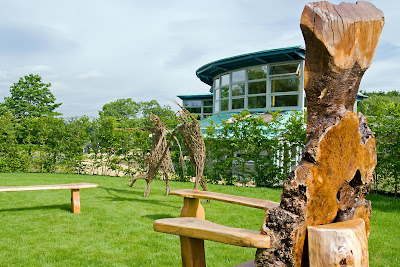
The 'story teller's chair' in the Teaching Garden at RHS Harlow Carr. The Bramall Learning Centre is in the background.

The bittersweet flavour continued to shape the week but at a far more trivial level. My time as a member of the Royal Horticultural Society's Council has come to an end.

Still wearing somber garb, we drove from John's service up to Harrogate for a tour of the brand new Bramall Learning Centre at Harlow Carr Garden. You can find details here but there's nothing like seeing it for yourself. What impressed was the way in which natural light floods the rooms. You feel that the garden is in the room with you, and when the trees lose their leaves and the skyline drops, in winter, the lower light source will create a different effect.

The library, in the Bramall Centre, is one of the most attractive I have ever entered. I kept sneaking back, pretending to look things up in books, but in reality, admiring the layout, the airiness and the accessibility. It's almost impossible to tear yourself away.

The building itself, we were told, is one of the greenest in Britain, complying with all the latest carbon-related diktats and recommendations. (Details here.)


At Betty's Restaurant, Harlow Carr, enjoyed a slap up dinner. This was given as a gesture of thanks to those of us who are leaving Council, and particularly to the retiring President, Giles Coode-Adams.

Giles was hastily handed the reins when Peter Buckley died so unexpectedly and so shockingly late in 2008, and found himself steering the Society through a rather difficult patch. He proved to be a strong, stable hand at the tiller, always maintaining a positive stance, always expressing calm confidence. I'm going to miss his wisdom and his positive attitude enormously.

At yesterday's Annual General Meeting, in a tent at Harlow Carr, I handed back my badge of office, along with the other outgoing Council members and walked away feeling a huge sense of relief, mingled with almost unbearable sadness.

There was also a sense of guilt – still is – because I had completed only eight of my allotted ten years. My dodgy physical condition, plus the need to take on more paid work than I expected to be doing at 66 – thank you, bankers, pension funds and other financial advisors! – meant that there was less time to give to the RHS. And it is never right to commit to any volunteer job, unless you are prepared to give it your all.

I'll still be doing lots for the RHS, but it will be less pressured.

I can also be far more objective when discussing the Society, or writing about it. And far less in inhibited about criticising, whenever I think it's going wrong. Perhaps some remarks about children? (But not now, not here and not - well, not yet, anyway.)

Thalictrum delavayi - my current favourite meadow rue.

The garden is a disgusting, weedy mess but some of the plants are looking wonderful and Wendy if busting out in tomatoes and cucumbers. I'm trying not to weep at the seeding sow thistles, but it's not easy.

I grow our native meadow common meadow rue, Thalictrum flavum which is quietly handsome, but not a patch on the delectable Asian species. It grows wild, in the Fen, so I feel it deserves its place on our side of the hedge, too.

T. delavayi is my current fave, though, pictured above. The tufted purple tassels of F. aquilegifolia make it a close second. There's also a double-flowered T. delavayi, but all I can say to that is why? When the single, lilac flowers are such a delight.

I'm listening to Beethoven's String Quartet Opus 59 no. 1 One of the Rasumovsky Quartets.

Film of the week was. Salon Kitty, a 1976 rudery by pornographer-cum-director (whoops, pardon missus) Tinto Brass. It's long, and dwells rather lingeringly on genitalia, perversions and abnormalities of a sexual nature. (Whatever normalities might be.) The piece also creates a preposterous vision of the Third Reich. But it is not nearly so bad a film as first appears. It begins with remarkably Cabaret-like sequences, borrowing from paintings by Otto Dix (also worth looking at here) and continues to undermine one's security with hideous visions of exploitation and deceit. Helmut Berger, as the immaculate, but repulsively degenerate 'model Nazi' is utterly convincing. The rest of the plot is weak as water, but the compelling, self-destroying process is hypnotic.

This time in 2002 I was in a state of mild shock, having just become a Council Member of the RHS. At Hampton court, that year, retiring member - Christine Skelmersdale and the ex-Treasurer, Martin Slocock wined and dined the PG and me, along with fellow council rookie and whizz kid landscape designer Michael Balston, at Hampton Court. No nancy table cloths or frilled waiters for us, thank you very much. No no! We formed our own little enclave, by the water, in a quiet corner, with our own hamper.

We had a table of sorts, and chairs, but more important than any of that, we had wine, wit, merriment and warm companionship. Two lasting memories of that night - apart from all the joy and stuff - was a gigantic basket of luscious, dark cherries and finishing the evening sipping a magnificent vintage white bordeaux. I'm pretty sure it was a Sauternes, but can't recall which estate it came from.

Oh, and here's the blushing confession: while everyone was watching the Hampton Fireworks, I discovered that I had absent-mindedly grabbed one of the bottles of the delectably raisiny, musty, golden wine and was swigging directly from it. Disgraceful! But then, at every good party there's always someone who just goes that bit too far.

Bye bye for now.

Friday, 25 June 2010

BROKEN PROMISES

Oncosperma tigillarium, one of the world's most elegant, clump-forming palms, a native of Thailand and Peninsular Malaysia. Shot in the Singapore Botanic Gardens. My shot.

Goodness me, I owe so many apologies. It is hardly believable that I've been back in 'blighty' for just over a week, and have failed, failed abysmally in my bright intentions to keep an illustrated blow by blow diary of our adventures in Singapore and Malaysia. What a feeble attempt - just two brief posts. But time did for me and having my passport pinched in Malacca was no help.

Now we're back and it's lovely and hot here, and amazingly, the garden is not dead. Wendy has picked up a couple of nasty infections, the shameless slut, so I've had to take action. I expected her to have a few problems but she's riddled with red spider which is a shock, when I think how lush and healthy everything was before I left!

Now then, Singapore. . .

Our main purpose was to help with judging Community Gardening projects, and for me to deliver a keynote address at their conference. Singapore National Parks Department administers the Community Gardening contest, but the main impetus has to come from the communities themselves. And although this is all relatively new, the uptake and growth has been excellent. 270 communities took part this year, in the contest - which has much in common with Britain in Bloom - but the number signed up for the next contest is up to 400.

Community gardeners, judges and NParks people at the Caribbean at Keppel Condominium, shot by the PG.

What struck me, apart from the enthusiasm of all the participants, was the diversity of social groups which have got stuck into hands-on gardening. Singapore is a small island accommodating 5 million souls. Land, and especially green growing land, is at a tremendous premium, and yet, the standard of horticulture is quite fantastic. And that goes for the best of the community gardens.

You might think that tropical conditions make it easy, but Singapore has possible the most challenging soil known to man. Any humus-rich, laterite forest soil eroded away centuries ago and all that is left is a hostile marine clay which handles like Plasticene.

And the climate is similar to being inside a mist propagator. Tropical rainforest species thrive, but the locals try to grow Mediterranean herbs such as lavender and thyme, and are bitterly disappointed with their results. 'Don't come to me with your hard luck stories,' I told them. ' I can't grow tropical limes, cardamoms or nutmegs.'


A government housing project community garden. Not sure which of us shot this!

When you visit Singapore as a tourist, the opulence, cleanliness and order is what strikes you - after you've recovered from the beauty of the planting everywhere. But as in any large city, there are relatively poor districts and yet, with community gardens, huge efforts have been made and some of the results are delightful. We were able to go up in a high rise building to look down on one particularly fine set of gardens. Each little plot is individually maintained, but the whole area is looked after by the community.


Statue of Chopin, in the Singapore Botanic Garden. (The PG.)

The initiative behind community gardening comes from the all-embracing National Parks Department. It is they who administer the contest, they who provide advice, help and encouragement to communities and it is they who must now bring this contest forward to embrace the wider population so that all parts of the city, and all sectors of society have the opportunity to be involved.

You might say, well, that's part of their job. But the folk we worked with seemed to be giving life and soul to this movement and its current rapid growth is largely due to their dedication, encouragement and support.

There are so many fabulous reasons for visiting Singapore - a vast tropical garden which happens to accommodate a large city. If you plan to fly to Australasia without taking a stopover break there, you'll be doing yourself out of a delightful experience.


Now, a final word about tropical fruits. Guavas, mangoes, jackfruit, mangosteens, pomelos, passion fruit, rambutans and dragon fruit are all delectable additions to the more familiar pineapples, watermelons and, of course, bananas.

But how about the Durian? You can find references here and here.
Back in 1969, on my first visit to Singapore, I was introduced to the durian. I was still groggy from a recent bout of 'flu - there was a nasty epidemic that year - and had totally lost my appetite. We were on a pig farm and the stink of the pigs, plus the clouds of flies which flew up whenever you moved, not to mention the oppressive heat, had combined to make me feel distinctly queazy.

'We have excerrent fluit for you,' said the pig man, in Chinese-sounding English. And sitting down at a crude table, in a shed next to the farrowing sows' pen, he proceded to break open a thing that resembled a giant horse chestnut fruit. Inside, instead of conkers, there were lobes of yellow-cream matter which resembled - well never mind. If you're not a vet, you probably wouldn't have seen what I was about to refer to anyway.

He globbed out the lobes, putting them onto a non-too-clean plate and offered them to me and to my father who was with us. 'Eat' he exhorted. 'It's good, good!' I managed a mouthful but shamefully, with stink of the durian masking the pig muck, I gagged.

Well, 41 years later, my dear friend Ng Cheow Kheng encouraged me to revisit the durian. He bought some, so fresh they were still wriggling, and so ripe that the husks were just on the point of splitting. He invited us into his wonderful flat, with stupendous views of the city, and there I plucked up my courage and had another go.

And do you know what? They are absolutely, utterly, totally delicious. The creaminess of the texture and the complex flavours have to be tasted to be believed. I can't believe I've wasted 41 years in which I could have enjoyed durians whenever I visited South East Asia. What a bummer - though that's probably not a good word in this context. No wonder people say of the durian, it smells like hell but tastes like heaven


The PG's record of my durian epiphany.

I'm looking at my sparkly new iPad and wondering if, when I synch it with my big Mac, it will mess up all the settings and scrub the stuff from my iPhone. I've already loaded it with A Tale of Two Cities. Well, you can't have a Dickens-free iPad, now can you?


This time two weeks ago I was tucking into fresh water prawns with soupy noodles and snarfing Tiger beer. I believe a gigantic banana split was consumed, but I'm not saying by whom.

I'm reading Joseph Conrad's Lord Jim. Gosh, how depressing!


Tuesday, 15 June 2010

MEE GORENG, YOU JAIN

REFLECTIONS ON MELAKA
I'm publishing this post half-written - bad blog etiquette! - but am about to depart for the next phase of our journey.

1. Five words you do NOT want to have to say, in any foreign country:
'My passport has been stolen.' It happened to me. I won't go into detail, but it involved an involuntary trip to Kuala Lumpur, two nights in an expensive hotel, begging and pleading with the folk at the British High Commission, receiving the new passport in record time, much to the relief of our Singapore Hosts who were waiting helplessly on the other side of the Johor Straits and finally - and scarily - being held at the Malaysian border for two hours while they decided whether to let me through to Singapore, or to send me back to Kuala Lumpur, for some bizarre reason known only to themselves.

Cyclists in Heeren Street, Melaka

But before that horrible drama, there was Melaka.

2. What an enchanting city! Partly a holiday resort for families, partly a living history lesson and generally, the usual Asian noise, muddle, traffic, hustle, bustle and well, just life! Our guest house, Heeren House, on the river, was in the oldest part of town. This is a Dutch style long house belonging to a couple who worked in the UK for much of their lives but have moved here. It was delightful, quaint, characterful and perfectly clean and comfortable. I'd recommend it over any of your opulent swanky chain hotels. When my passport went missing, the proprietor, Liz, was incredibly supportive and helpful.

Holiday Traffic in Melaka

3. The calling of the Muslim faithful to prayer - a regular sound in Malaysia - was blended, here, with the clanging of church bells from Saint Xaviour's Catholic Church - twin tugs on the kindly fetters of religion. The Portuguese brought catholicism here in the 16th Century but there's also a big protestant church. Women cover their heads, but not their faces.

A traditional Melaka house

4. Baba and Nonya. This is a fusion culture - Chinese blended with Malay. It's a bit like the Creole culture of America, but Eastern. The houses are developed in the Chinese style but with large, open 'air wells' in their centres so that the chimney effect created by the central void draws in fresh air.

Baba and Nonya food is a wonderful fusion of Malay and Chinese noodles etc. Spices are used liberally, but blended subtly and although fish and chicken are writ large, freshwater prawns also figure and are delicious. The also love sweet things - bless them - and a favourite dish is shaved ice with a kind of jelly and syrup made from pandanus sap which has been reduced to a molasses-like consistency.

oops - the man's come for the baggage. All I've got time for. Tooodle-oo.

Monday, 7 June 2010

SUNDRY SINGAPORE SLINGS

The strange photo was, indeed, a rambutan Nephelium lappaceum, on my last post. A bouquet of eOrchids to those who got it. I believe 'rambutan' means 'hairy' in Malay and the fruits, whose arils are deliciously succulent and sweet, do resemble lychees. But the shape, like small rugby balls, and the curly hairs - not to mention the reddish skin - can be a little off-putting!


Birds Nest Ferns, Asplenium nidus with other epiphytes, on a tree in Singapore.

'Ooooh, it's too 'ot,' said the chap delivering an order from Amazon the other day, at home. The temperature, then, must have been creeping up towards, ooh, about 20ºC. (68ºF.) Here in South East Asia, it's a whisker over 30ºC and so humid that my glasses steam up the minute I step out of a cooled car into the open air.

You learn to cope with such oppressive conditions, but at first, it feels as though the climate has assaulted you. On our first day, I felt rather as I did when I was nine, and a slightly sweaty Great Aunt hugged me to her bosom a little too enthusiastically. You enjoy the attention but wish it weren't quite so suffocating. That particular lady remained a spinster until she was 76 but then rediscovered romance, married and skipped off to New Zealand for a few blissful final years - but that's quite another story.

The first days of our visit here have been spent largely with staff from National Parks, looking at several of the projects that have made Singapore so green and so pleasant to be in. The government's approach to horticulture, and to sustaining the nation, as a genuine garden city - eat your hearts out, Welwyn and Stevenage! - stems from the original, founding policy. The plan to create a city in a garden - which goes back thirty years or more - has been backed up constantly, by substantial funding and by adhering to that founding policy.

But theres a great deal more, here. They've had pluck and daring, defying recessions, refusing to compromise on quality and constantly maintaining horticultural standards. Everyone, wherever they live, will be within a short walk of a restful green space. And in such a densely populated small island, that has taken cunning, determination and above all, combined will.

One project we visited was Hortparks. You can look up details here, rather than have me load you with inaccurate info. They were putting finishing touches to their new Silver Garden, when we visited. And that's typical Singapore - always trying something that probably won't work, and then making it work, regardless. The sparky Wilson Wong (you may remember him from Monty Don's TV programme Around the World in 80 Gardens) pointed out that there are very few silver-foliage plants which enjoy equatorial conditions. But here, silver Bismarckia palms and other plants look fantastic.


The bubbly Wilson Wong, sitting in the spice garden he designed for Hortpark.

Wilson is also involved with the growing Community Gardening organisation, here, and has been something of a leading light. But more of that later.


The Silver Garden at Singapore's HortPark.

You've nearly had enough eulogistic writing, but really, this place is so inspiring. One final point which shows how cunning use of plants can make things feel different: all major roads are required to have a 6 metre ribbon, on either side, which must be planted up with naturalising trees.

We met the amazingly enthusiastic Ganesan SK (his Tamil surname, he says, is too complicated, so we were to used his initials.) He trained at Edinburgh University and has an inexhaustible knowledge of tropical trees. He is responsible for the tree strips, among other things, and takes great pride in his work. He's also an erudite birder and keen naturalist. I wish we could have spent a week with him - gosh, what we'd have learnt!


Ganesan proudly shows us his 6 metre strip.

But think about it. If every A and B road in the UK had a 6 metre tree strip, how about that for wildlife corridors, for cooling the roads, for providing valuable habitat for so many species and for making the landscape beautiful. But what do we do? We cut the verges to within an inch of their lives, killing cowslips and other verge flowers, thereby helping to kill bees. What prats we are! And don't tell me land is too valuable in UK. What, compared with here???? Don't get me started!!!!

Let the epiphytes grow where they will - a wiser initiative for biodiversity.

A final point. The Singapureans, prissy though they can be, are also beginning to understand that tidiness can be a killer for biodiversity. Originally, epiphytes - plants that grow on trees but which do not parasatise them - were considered weeds and undesirable. They were regularly cleaned off. Now, however, they are left undisturbed. As a result, species counts are growing and to me, the trees look just as any tropical rainforest tree should look - rich, enticing, rustling with life of all kinds and wonderful to behold.

I was listening to Miles Davis, in a supermarket earlier. I think it was from the album 'Relaxin' and was certainly a surprise, among the rambutans, noodles and blocks of Chinese tea.

This time last year I haven't a clue what I was doing. But the next post will be from Melaka, Malaysia.

No films. Just reading Nicholas Nickleby instead. I refuse to watch films on flights. They just don't work, for me.

Hope June is flaming for you. Did someone volunteer to water my tomatoes???
Bye bye.

Friday, 4 June 2010

THUNDER AT SUNRISE


POST CARD FROM SINGAPORE, NUMERO UNO.

What is this?

No time to say much but first, a little game. If you can identify the picture, there'll be a prize of some sort - possibly an electronically blown kiss of congratulation, or maybe an eOrchid.


Now, then. What ho and howdedo??!!!

I knew we were in the tropics when a ruddy great clap of thunder jerked my jet-lagged body into rigid and terrified wakefulness just before dawn. It had taken from 10pm until an hour before, to get to sleep, so I began the day in a state of exhausted apprehension!

Talk about hot! You need five changes of underwear, here, daily and whenever you sit outside, you keep wishing someone would open a huge window somewhere, and let in some fresh air.

Our wonderful hosts - and there are hosts of them - will shortly be here to take us off to visit the Gardens By The Bay. We've already done some preliminary judging of shortlisted community gardens and spent a fascinating - and delightfully recuperative - day working through the Singapore Botanic Garden (details here) with curator, Dr Chin See Chung.

A few comments:

1. Anyone who needs lessons in how to be really hospitable to visitors should visit Singapore.

2. I have a notion that the inhabitants of this city have a different metabolism from us cold-blooded Brits. I've never seen such constant, dedicated, committed eating. The food here is out of this world, and everyone seems to be tucking in almost constantly, yet relatively few people appear to be heavy. When one sees a sagging belly, I mean other than when trying to avoid looking at the bathroom mirror of a morning, the sound that accompanies will usually have Anglo-saxon connections.

3. You really can create a garden in a city, even one with almost 5,000,000 souls crammed into a small, equatorial island. More on that later.

4. There are insects in the rainforest which can cover you with bites and yet which are totally, one hundred percent invisible. I spent moments under a dipterocarp tree can was instantly covered with itchy blobs.


The view from our hotel window. Not the most impressive until you realise that this is the heart of a city with 5 million souls and yet which, in places, feels greener than my rural home. And don't you just adore tropical skies?

I'm listening to the PG, agitating for us to go down to breakfast. She's obviously caught SES (Singapore Eating Syndrome.)

More soon - bye bye!